Signs You’re Not Audit-Ready (Even If You Think You Are)
Most finance teams assume they’re audit-ready the moment the financial statements are done.
Then the external auditor arrives, asks for the schedule behind a single receivable balance, and the adjustments start piling up — reconciling differences, unsupported balances, missing approvals. What looked like clean books turns into weeks of scrambling and an audit opinion that takes far longer to get than planned.
The gap is rarely in the numbers themselves. It’s in what stands behind them. Here are the signs your business only looks audit-ready — and what to fix before your auditor finds them first.
Quick Answer: How Do You Know If Your Business Is Actually Audit-Ready?
A business is audit-ready when its financial statements are fully supported by documentation, reconciliations, and internal controls an auditor can trace and verify — not just numbers that look correct.
The markers of genuine readiness:
- Every account balance has a supporting schedule or reconciliation, not just a journal entry
- Bank reconciliations are current and reviewed monthly, not compiled at year-end
- Fixed asset and inventory records match physical counts
- Related-party transactions are documented and disclosed
- Approvals for major transactions exist on paper, not just in someone’s memory
- Prior-year audit findings have been resolved, not carried forward unaddressed
What Does “Audit-Ready” Mean for a Philippine Business?
Audit-ready means your financial records can withstand independent verification without requiring last-minute reconstruction of support.
In practice, this means:
- Financial statements are prepared under the applicable Philippine Financial Reporting Standards framework for your entity’s size, with consistent policies applied period over period
- Every material balance — cash, receivables, inventory, fixed assets, payables — has documentation an external auditor can trace to source
- Internal controls exist and are followed consistently, not just written down in a manual nobody uses
- The company can produce requested schedules within days, not weeks
1. You Prepare Financial Statements, But Can’t Explain the Numbers Behind Them
If your finance team can produce a balance sheet but struggles to explain how a specific receivable balance was derived, that’s a readiness gap. Auditors don’t just want the total — they want the trail: aging schedules, subsidiary ledgers, and reconciliations that tie back to the general ledger.
Fix: Require every material account to have a standing reconciliation template, updated monthly, not reconstructed at year-end.
2. Your Books Close, But Reconciliations Lag Behind
Many companies close their books monthly for management reporting but only reconcile bank accounts, intercompany balances, or fixed assets once a year — usually right before the audit. This is one of the most common sources of audit delays and adjusting entries.
Fix: Move bank, intercompany, and subsidiary ledger reconciliations to a monthly cadence, reviewed and signed off by a supervisor.
3. Approvals Exist Informally, Not in Writing
A common finding: transactions above a certain threshold were “approved,” but there’s no signed authorization, email trail, or board resolution to show it. Auditors treat unsupported approvals as a control weakness, even when the transaction itself is legitimate.
Fix: Document an approval matrix — who signs off on what, at what amount — and keep the evidence on file, not just in someone’s inbox.
4. Physical Assets and Inventory Don’t Match the Books
If your fixed asset register or inventory count hasn’t been physically verified against what’s actually on the ground in over a year, expect audit adjustments. Auditors will ask to observe counts or review count documentation — and discrepancies here are one of the most frequent causes of qualified findings.
Fix: Conduct at least an annual physical count with a reconciliation to book values, documented with sign-offs.
5. Prior-Year Audit Findings Were Never Closed Out
If last year’s management letter flagged issues — weak segregation of duties, incomplete documentation, unreconciled accounts — and nothing changed, auditors will flag it again, often with more scrutiny the second time around.
Fix: Track prior-year findings in a corrective action log and close each item with evidence before the next audit begins.
Quick Answer: How Do Businesses Actually Become Audit-Ready?
Businesses become audit-ready by treating audit preparation as a year-round discipline, not a pre-audit scramble.
What that looks like in practice:
- Maintain monthly reconciliations for all material accounts
- Keep a documented approval matrix for transactions and disbursements
- Perform physical counts of inventory and fixed assets at least annually
- Track and close out prior audit findings systematically
- Assign clear ownership for each schedule the auditor will request
- Run an internal self-assessment before engaging external auditors
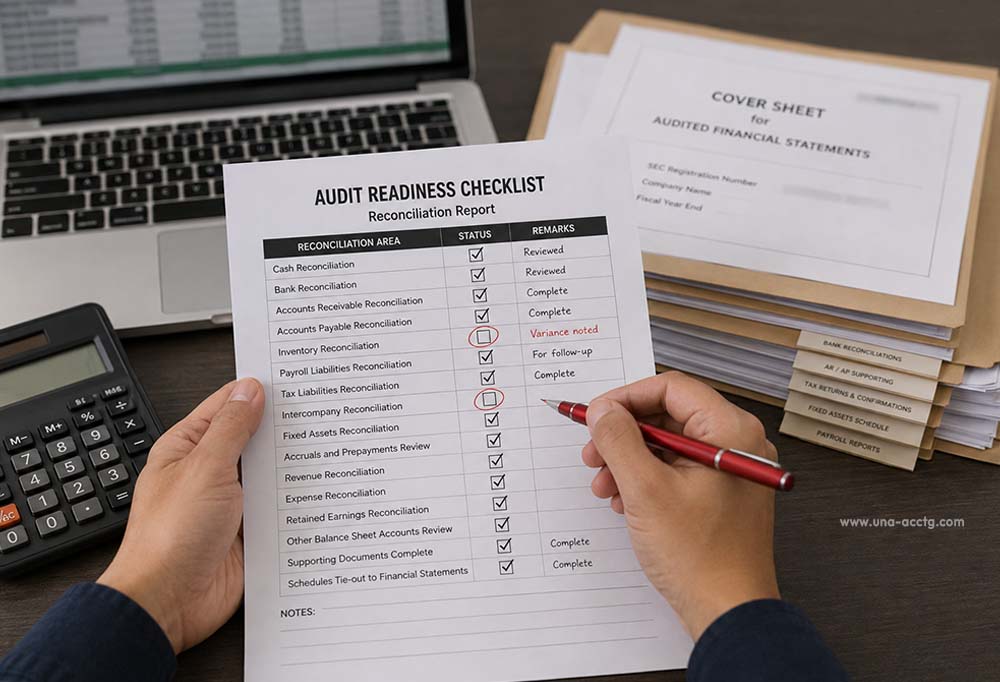
Audit Readiness Checklist: A Practical Self-Assessment
Monthly
- Bank reconciliations completed and reviewed within 5 business days of month-end
- Accounts receivable and payable aging schedules updated and reviewed
- Intercompany balances reconciled between entities
Quarterly
- Fixed asset additions and disposals reconciled to the register
- Approval matrix reviewed for compliance on major transactions
- Related-party transactions documented and disclosed
Annually, Before Audit Season
- Physical count of inventory and fixed assets completed and reconciled
- Prior-year audit findings reviewed and confirmed closed
- Supporting schedules for every material balance compiled and ready for request
- Internal self-assessment conducted to surface gaps before the auditor does
The Bottom Line
Being audit-ready isn’t about having financial statements that look correct — it’s about having the documentation, reconciliations, and controls to prove they are correct, on demand.
The businesses that sail through their audits aren’t the ones with perfect numbers. They’re the ones that closed the gaps before the auditor walked in. If any of the signs above sound familiar, the time to address them is before your engagement letter is signed, not after.
Find the Gaps Before Your Auditor Does
Every sign in this article is fixable but only if you find it first. Once fieldwork begins, each gap becomes an adjusting entry, a management letter comment, or a delay in your audit opinion.
UNA Tax and Accounting Services is an accounting firm in Metro Manila that helps Philippine businesses close documentation, reconciliation, and control gaps ahead of audit season; so your auditor spends their time verifying your numbers, not reconstructing them.
UNA can help you:
- Assess your readiness against what auditors actually request
- Build reconciliation and approval documentation that holds up under review
- Close out prior-year audit findings with evidence
- Prepare supporting schedules before fieldwork begins