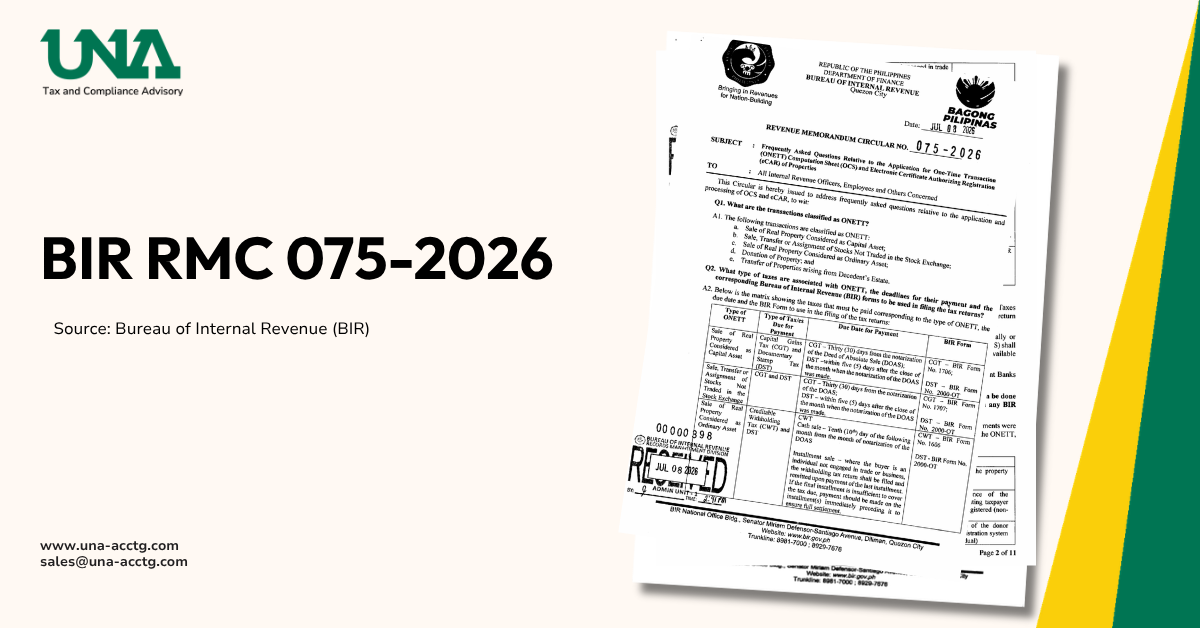
BIR Clarifies ONETT Tax Deadlines and eCAR Filing Rules Under RMC No. 075-2026
Quick Answer: When are ONETT taxes due? Capital Gains Tax and Donor’s Tax are due within 30 days of notarization, Estate Tax within 1 year of death, and Documentary Stamp Tax within 5 days after the month of notarization — and all returns must now be filed electronically.
- Capital Gains Tax (sale of real property/stocks as capital asset): 30 days from notarization
- Donor’s Tax: 30 days from notarization of the Deed of Donation
- Estate Tax: 1 year from date of death
- Documentary Stamp Tax: 5 days after the close of the month of notarization
- Filing method: electronic by default under RA 11976 (Ease of Paying Taxes Act)
On July 8, 2026, the Bureau of Internal Revenue issued RMC No. 075-2026, a consolidated FAQ addressing common questions on One-Time Transactions (ONETT) — covering the ONETT Computation Sheet (OCS) and Electronic Certificate Authorizing Registration (eCAR).
What ONETT covers:
- Sale of real property classified as a capital asset
- Sale, transfer, or assignment of stocks not traded on the stock exchange
- Sale of real property classified as an ordinary asset
- Donation of real or personal property
- Transfer of property arising from a decedent’s estate
Key clarifications:
- Filing of ONETT-related tax returns must now be done electronically, with manual filing allowed only when BIR’s e-filing platforms are unavailable. Payment may still be made manually over the counter with Authorized Agent Banks, or electronically — though eFPS-enrolled taxpayers must continue using eFPS unless the required form isn’t yet available there.
- eCAR processing remains tied to the Revenue District Office (RDO) with jurisdiction over the transaction — the property’s location for sales, the seller’s or donor’s residence for stock sales and donations, and the estate’s TIN jurisdiction for estate transfers — regardless of where the return was filed or tax paid.
Our Take: This RMC doesn’t introduce new tax rates or deadlines — it consolidates existing rules into one reference so taxpayers and practitioners stop guessing. In our experience, the most common ONETT compliance failures come from missing the 30-day CGT/Donor’s Tax window because sellers and donors don’t realize the clock starts at notarization, not at closing. If you have a property sale, donation, or estate settlement in progress, this is a good moment to double-check your filing timeline against these confirmed deadlines.
Frequently Asked Questions
Do I need to file ONETT returns online now?
Yes — electronic filing is the default under the Ease of Paying Taxes Act, with manual filing allowed only if BIR’s e-platforms are down.
Where do I apply for my eCAR?
At the RDO with jurisdiction over the transaction — this depends on the property’s location, or the seller’s/donor’s residence, not necessarily where you paid your taxes.
What happens if I miss the 30-day CGT deadline?
Late filing triggers surcharges and interest and can delay the eCAR issuance needed to transfer title.
Source: Revenue Memorandum Circular No. 075-2026, issued July 8, 2026.